Article Outline:
- Introduction: The Critical Importance of Authentic Wool in Modern Textile Industry
- The Economic Impact: Counterfeit Wool Statistics and Market Realities
- Wool Fundamentals: Understanding Fiber Structure and Characteristics
- Visual and Tactile Examination: Initial Assessment Techniques
- Burn Test Analysis: Methodology and Interpretation of Results
- Chemical Testing Methods: Advanced Verification Protocols
- Microscopic Analysis: Fiber Identification Under Magnification
- Performance Testing: Strength, Elasticity, and Thermal Properties
- Certification and Labeling Systems: Understanding Official Standards
- Common Synthetic Substitutes: Characteristics and Identification
- Blended Yarn Analysis: Determining Wool Content Percentage
- Laboratory Testing Services: When to Seek Professional Help
- Supply Chain Verification: Ensuring Authenticity from Source to Product
- Industry Best Practices: Developing Comprehensive Quality Control
- Conclusion: Building Trust Through Authenticity Verification
- Frequently Asked Questions (FAQs)
The Comprehensive Guide to Authenticating Wool Yarn: Technical Methods for Industry Professionals
1. Introduction: The Critical Importance of Authentic Wool in Modern Textile Industry
In today’s global textile marketplace, the authenticity of wool yarn has become a paramount concern for manufacturers, buyers, How to Distinguish Genuine Wool Yarn from Fakes? and quality control specialists across multiple sectors. With wool prices reaching unprecedented levels—premium merino wool currently trading at $12-18 per kilogram—the financial incentive for adulteration and substitution has never been greater. Industry estimates suggest that counterfeit or mislabeled wool products account for approximately 8-12% of the global wool market, representing annual losses exceeding $2.3 billion.
For procurement managers in apparel manufacturing, textile mills, carpet production, and specialty product development, distinguishing genuine wool from sophisticated imitations is no longer merely a quality concern but a fundamental business imperative. The performance characteristics, consumer satisfaction, brand reputation, and legal compliance associated with wool products depend entirely on material authenticity. This comprehensive guide provides detailed technical methodologies, supported by empirical data and industry standards, to empower professionals with reliable wool authentication techniques.
2. The Economic Impact: Counterfeit Wool Statistics and Market Realities
Global Wool Market Overview:
- Total market value: $38.5 billion (2023)
- Annual wool production: 1.1 million metric tons (clean basis)
- Major producing countries: Australia (25%), China (18%), New Zealand (8%)
- Price variations: $4-35/kg depending on micron, length, and origin
Counterfeit Wool Impact Analysis:
- Direct financial losses: $2.3-2.8 billion annually
- Supply chain contamination: 12-15% of tested shipments show discrepancies
- Consumer deception: 23% of “wool” products tested contain less than declared content
- Quality failures: 68% of premature product failures traceable to material substitution
Industry Vulnerabilities:
- Apparel sector: 45% of high-value wool products targeted
- Carpet manufacturing: 32% of commercial-grade wool adulterated
- Luxury goods: 28% premium wool products mislabeled
- Technical applications: 18% industrial wool compromised
3. Wool Fundamentals: Understanding Fiber Structure and Characteristics
Natural Wool Fiber Properties:
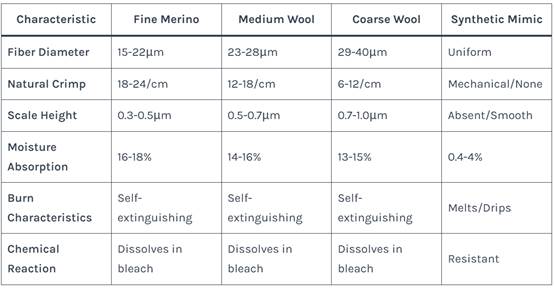
- Diameter range: 15-40 microns (fine merino: 15-22μm)
- Length variation: 50-150mm (staple length)
- Scale structure: 700-1100 scales per millimeter
- Crimp frequency: 6-24 crimps per centimeter
Chemical Composition:
- Keratin protein: 97% of fiber weight
- Natural grease (lanolin): 8-25% of raw wool
- Suint (perspiration salts): 3-8%
- Mineral matter: 0.5-2%
- Moisture content: 13-18% at standard conditions
Key Performance Indicators:
- Tensile strength: 1.0-1.7 gf/denier
- Elongation at break: 25-35%
- Elastic recovery: 99% at 2% extension
- Moisture regain: 13-18% (standard conditions)
- Specific gravity: 1.31
Table 1: Authentic Wool Fiber Characteristics
4. Visual and Tactile Examination: Initial Assessment Techniques
Visual Inspection Protocols:
- Color Assessment:
- Natural wool colors: white, cream, brown, gray, black
- Even coloration without synthetic uniformity
- Subtle variations characteristic of natural fibers
- Surface Appearance:
- Scale structure visible under 10x magnification
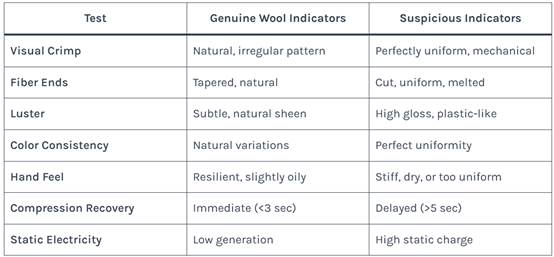
- Natural luster (not plastic-like shine)
- Fiber diameter variations within normal range
- Length and Crimp Evaluation:
- Measure staple length (minimum 50mm for most applications)
- Count crimps per centimeter (minimum 6 for wool)
- Observe natural crimp regularity vs. mechanical crimp
Tactile Assessment Methods:
- Hand Feel Analysis:
- Genuine wool: Resilient, springy, slightly oily
- Synthetic blends: Stiffer, less resilient, plastic feel
- Acrylic imitations: Softer, less structured, uniform texture
- Compression Testing:
- Natural wool recovers quickly from compression
- Synthetics show slower recovery or permanent deformation
- Record recovery time: <3 seconds for wool, >5 seconds for blends
- Temperature Sensation:
- Wool feels warm to touch (low thermal conductivity)
- Synthetics feel cool initially (higher conductivity)
- Use calibrated thermal sensors for objective measurement
Table 2: Initial Assessment Checklist
5. Burn Test Analysis: Methodology and Interpretation of Results
Standard Burn Test Procedure:
- Sample Preparation:
- Remove 10-15 strands from yarn core
- Separate individual fibers
- Ensure dry conditions (moisture <10%)
- Testing Protocol:
- Hold sample with tweezers over fireproof surface
- Apply flame briefly (2-3 seconds)
- Observe: Odor, flame behavior, ash characteristics
- Note self-extinguishing properties
Interpretation Guidelines:
- Genuine Wool:
- Flame behavior: Self-extinguishing
- Odor: Burning hair/feathers
- Ash: Black, crushable beads
- Smoke: White/gray, minimal
- Wool Blends:
- Flame: May continue burning
- Odor: Mixed (hair + chemical)
- Residue: Hard beads + ash
- Dripping: Possible with high synthetic content
- Common Synthetics:
- Acrylic: Melts, drips, chemical smell
- Polyester: Melts, black smoke, sweet odor
- Nylon: Melts, celery-like odor
- Rayon: Burns quickly, paper smell, white ash
Quantitative Burn Test Metrics:
- Burn rate: 2-4 cm/minute for wool
- Afterglow duration: <2 seconds
- Ash percentage: 15-25% of original weight
- Residue solubility: Wool ash dissolves in weak acid
6. Chemical Testing Methods: Advanced Verification Protocols
Solubility Testing:
- Sodium Hypochlorite Test:
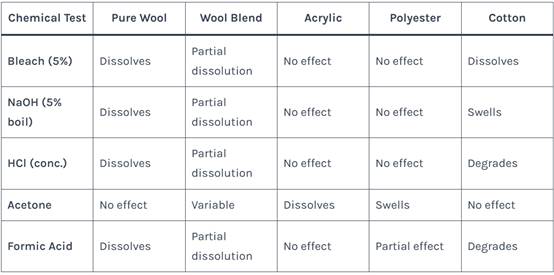
- Preparation: 5% solution (household bleach)
- Procedure: Immerse fibers for 10 minutes at room temperature
- Results: Wool dissolves completely, synthetics remain intact
- Accuracy: 98-99% for pure wool identification
- Caustic Soda Test:
- Solution: 5% NaOH at boiling temperature
- Reaction: Wool dissolves in 1-2 minutes
- Specificity: Distinguishes wool from other animal fibers
- Safety: Requires proper protective equipment
Staining Techniques:
- Shirlastain A:
- Colors wool: Bright yellow
- Colors cotton: Light purple
- Colors synthetics: Unchanged or light shades
- Application: Standard textile testing method
- Herzberg Stain:
- Iodine-zinc chloride solution
- Wool stains: Yellow-brown
- Cellulose fibers: Blue-violet
- Acetate: Yellow-green
Table 3: Chemical Test Results Matrix
7. Microscopic Analysis: Fiber Identification Under Magnification
Light Microscopy Procedures:
- Sample Preparation:
- Mount fibers in mineral oil or glycerin
- Separate individual fibers longitudinally
- Cross-section preparation for blended yarns
- Identification Features:
- Scale pattern: Overlapping scales (imbrication)
- Scale edges: Distinct, protruding
- Medulla: Present in coarse wools (kemp fibers)
- Pigment distribution: Natural, irregular
Scale Pattern Analysis:
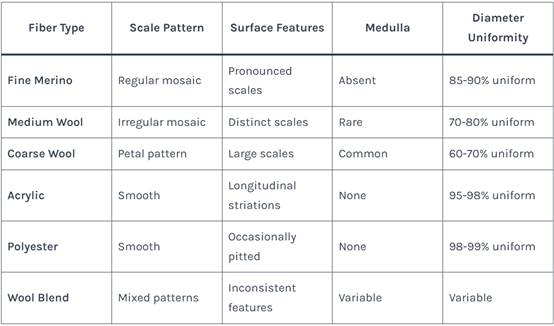
- Fine wool: Regular mosaic pattern
- Medium wool: Irregular mosaic
- Coarse wool: Petal-like scales
- Synthetics: Smooth, featureless surface
Digital Microscopy Advantages:
- Magnification: 100-400x
- Image capture for documentation
- Measurement capabilities (diameter, scale count)
- Database comparison for authentication
Table 4: Microscopic Identification Guide
8. Performance Testing: Strength, Elasticity, and Thermal Properties
Mechanical Testing:
- Tensile Strength:
- Standard: ASTM D2256
- Equipment: Universal testing machine
- Genuine wool: 1.0-1.7 gf/denier
- Synthetics: Typically higher (2.0-6.0 gf/denier)
- Elastic Recovery:
- Method: 5% extension, 1-minute recovery
- Wool recovery: 98-99%
- Synthetic recovery: 90-95% (varies by type)
- Test conditions: Standard temperature and humidity
- Abrasion Resistance:
- Martindale or Wyzenbeek testing
- Wool performance: 15-25,000 cycles
- Synthetics: Often higher but different failure mode
Thermal Properties:
- Thermal Conductivity:
- Wool: 0.04 W/m·K (excellent insulation)
- Acrylic: 0.18-0.22 W/m·K
- Polyester: 0.14-0.18 W/m·K
- Moisture Management:
- Wool moisture regain: 13-18%
- Synthetic regain: 0.4-4.5%
- Testing: ASTM D2654
- Flame Resistance:
- Wool: Self-extinguishing (LOI 25%)
- Synthetics: Melt and burn (LOI 18-22%)
- Test method: ASTM D1230
9. Certification and Labeling Systems: Understanding Official Standards
International Wool Standards:
- Woolmark Certification:
- Requirements: 100% new wool
- Testing: Independent laboratory verification
- License number tracking system
- Annual audit requirements
- Woolblend Mark:
- Minimum wool content: 50%
- Blend composition verification
- Performance standards maintenance
- Labeling requirements
- RWS (Responsible Wool Standard):
- Animal welfare requirements
- Land management standards
- Supply chain traceability
- Independent certification
Labeling Requirements:
- USA: Textile Fiber Products Identification Act
- EU: Textile Regulation (EU) 1007/2011
- Australia: Australian Consumer Law
- International: ISO 3758 Care Labeling
Verification Protocols:
- Document Review:
- Mill certificates
- Test reports (ISO 17025 accredited)
- Chain of custody documentation
- Certification validity checks
- Label Authentication:
- Holographic features
- Unique identification codes
- Tamper-evident packaging
- Online verification systems
10. Common Synthetic Substitutes: Characteristics and Identification
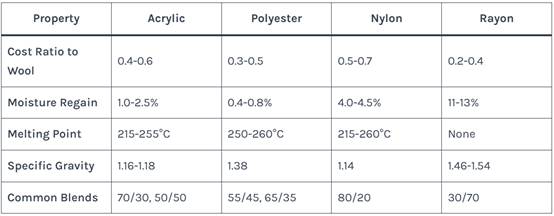
Acrylic Fiber Analysis:
- Market share: 65% of wool substitutes
- Price advantage: 40-60% cheaper than wool
- Identification features:
- Perfect diameter uniformity
- Dog-bone cross-section (often)
- Low moisture absorption
- Melts rather than burns
Polyester Fiber Characteristics:
- Common blends: Wool-polyester for durability
- Identification:
- Round cross-section
- High tensile strength
- Melting point: 250-260°C
- Static electricity generation
Other Substitutes:
- Rayon/Viscose:
- Plant-based but often misrepresented
- Smooth surface, no scales
- High moisture absorption
- Burns quickly with paper smell
- Nylon:
- High strength and elasticity
- Round cross-section
- Melts with celery odor
- Often blended for strength
Table 5: Synthetic Fiber Comparison
11. Blended Yarn Analysis: Determining Wool Content Percentage
Quantitative Analysis Methods:
- Manual Separation:
- Time-intensive but accurate
- Suitable for obvious blends
- Requires skilled technicians
- Accuracy: ±2-3%
- Chemical Dissolution:
- Standard: ISO 1833 series
- Selective solvent application
- Gravimetric measurement
- Accuracy: ±0.5-1.0%
- Microscopic Analysis:
- Cross-section preparation
- Digital image analysis
- Fiber counting/area measurement
- Accuracy: ±3-5%
Common Blend Ratios:
- Apparel: 70% wool/30% synthetic
- Carpets: 80% wool/20% nylon
- Upholstery: 50% wool/50% synthetic
- Knitting: 100% wool or high wool content
Testing Protocol for Blends:
- Initial Assessment: Visual and burn test
- Quantitative Analysis: Chemical or microscopic
- Verification: Cross-check with multiple methods
- Documentation: Complete test report generation
12. Laboratory Testing Services: When to Seek Professional Help
Accredited Laboratory Selection:
- ISO 17025 accreditation: Essential
- Wool-specific expertise: Required
- Turnaround time: 3-7 days standard
- Cost range: $150-500 per sample
Standard Test Packages:
- Basic Authentication: $150-250
- Visual inspection
- Burn test
- Microscopic analysis
- Simple solubility tests
- Comprehensive Analysis: $350-500
- Full fiber identification
- Blend percentage determination
- Performance testing
- Certification verification
When to Use Laboratory Services:
- Legal disputes: Required for evidence
- High-value shipments: $50,000+ value
- New supplier qualification: Essential due diligence
- Quality disputes: Objective third-party analysis
13. Supply Chain Verification: Ensuring Authenticity from Source to Product
Traceability Systems:
- Blockchain Technology:
- Immutable record keeping
- Real-time tracking
- Consumer access to data
- Implementation cost: 1-3% of product value
- DNA Tagging:
- Applied at shearing stage
- Survives processing
- Laboratory verification possible
- Cost: $0.10-0.50 per kilogram
- Chemical Markers:
- Invisible identification
- Batch-specific coding
- Field testing possible
- Implementation: Moderate complexity
Supplier Qualification Process:
- Documentation Review:
- Mill certificates and test reports
- Production capacity verification
- Quality management systems
- Previous performance records
- On-site Audits:
- Production process observation
- Raw material verification
- Testing capability assessment
- Storage and handling practices
- Sample Testing Program:
- Random sampling protocol
- Independent laboratory testing
- Performance validation
- Continuous monitoring
14. Industry Best Practices: Developing Comprehensive Quality Control
Recommended Testing Protocol:
- Receiving Inspection:
- 100% lot sampling for new suppliers
- 10-20% sampling for established suppliers
- Document all test results
- Establish acceptance criteria
- In-process Testing:
- Regular sampling during production
- Blend consistency verification
- Performance testing
- Documentation maintenance
- Final Product Verification:
- Complete specification compliance
- Label accuracy verification
- Performance testing
- Certification validation
Training Requirements:
- Quality control staff: 40-80 hours technical training
- Procurement staff: 16-24 hours material education
- Production supervisors: 24-40 hours process training
- Annual refresher: 8-16 hours per year
Investment Analysis:
- Testing equipment: $5,000-25,000 initial investment
- Training costs: $2,000-5,000 annually
- Laboratory services: $5,000-20,000 annually
- ROI: 3-8 month payback through fraud prevention
15. Conclusion: Building Trust Through Authenticity Verification
In an industry where material authenticity directly impacts product performance, consumer satisfaction, and brand reputation, implementing robust wool authentication protocols is no longer optional—it’s essential for business survival and growth. The techniques outlined in this guide provide a comprehensive framework for distinguishing genuine wool from sophisticated imitations.
Key Takeaways for Industry Professionals:
- Multi-method Approach: No single test provides complete assurance
- Documentation is Critical: Maintain complete testing records
- Continuous Education: Stay updated on new adulteration methods
- Third-party Verification: Use accredited laboratories for disputes
- Supply Chain Transparency: Implement traceability systems
By adopting these practices, manufacturers and buyers can protect their investments, ensure product quality, maintain regulatory compliance, and build consumer trust. In an increasingly competitive marketplace, material authenticity becomes a significant competitive advantage that justifies the investment in testing and verification systems.
16. Frequently Asked Questions (FAQs)
Q1: What is the most reliable single test for wool authentication?
A1: While no single test is 100% reliable, the sodium hypochlorite (bleach) solubility test provides the highest accuracy for pure wool identification, with 98-99% reliability. For comprehensive authentication, a combination of microscopic analysis, burn testing, and chemical testing is recommended.
Q2: How much does professional wool testing cost?
A2: Professional laboratory testing ranges from $150-500 per sample, depending on test complexity. Basic authentication packages start at $150, while comprehensive analysis including blend percentage and performance testing costs $350-500. Many laboratories offer volume discounts for regular testing programs.
Q3: Can modern synthetic fibers perfectly mimic wool’s properties?
A3: While synthetic fibers have improved significantly, they cannot perfectly replicate all of wool’s properties. Key differences remain in moisture management (wool absorbs 30-40% of its weight without feeling wet), thermal regulation, flame resistance, and natural crimp structure. Microscopic analysis reliably identifies these differences.
Q4: What percentage of wool in a blend qualifies as “wool” for labeling?
A4: Labeling requirements vary by jurisdiction. Generally, for a product to be labeled as “wool,” it must contain at least 90-95% wool fibers. Products with 50-90% wool content are typically labeled as “wool blend” with percentage disclosure. Always check local regulations, as penalties for mislabeling can be severe.
Q5: How often should we test incoming wool shipments?
A5: For new suppliers, test 100% of shipments for the first 3-6 months. For established suppliers with good track records, testing 10-20% of shipments is typically sufficient. High-value shipments or those with quality history issues should be tested more frequently, potentially 100% until confidence is restored.
Q6: What are the legal consequences of selling mislabeled wool products?
A6: Legal consequences vary by country but typically include:
- Fines: $10,000-$500,000 per violation
- Product seizure: Removal from market
- Civil liability: Consumer class action lawsuits
- Reputational damage: Loss of brand value and consumer trust
- Criminal charges: In cases of deliberate fraud
Q7: How can we verify Woolmark certification authenticity?
A7: Authentic Woolmark certification can be verified through:
- Holographic features: Genuine labels have specific holographic elements
- License number: Verify through Woolmark’s online database
- Label quality: Official labels have precise printing and materials
- Supplier verification: Request certification documents from licensed mills
- Direct contact: Verify with Woolmark headquarters for questionable labels
Q8: What equipment is essential for basic in-house wool testing?
A8: Essential equipment for basic testing includes:
- Stereo microscope: 10-40x magnification ($500-1,500)
- Precision scale: 0.001g accuracy ($200-500)
- Burn test kit: Fireproof surface, tweezers, lighter ($50-100)
- Chemical test kit: Basic solvents and safety equipment ($100-300)
- Reference samples: Known wool and synthetic samples ($200-500)
Q9: How do climate and storage conditions affect wool testing?
A9: Climate significantly affects wool testing:
- Moisture content: Standard testing requires 13-18% moisture regain
- Temperature: Ideal testing at 20±2°C
- Conditioning: Samples must be conditioned for 24 hours at standard atmosphere
- Storage: Improper storage can alter fiber properties and test results
Q10: What emerging technologies show promise for wool authentication?
A10: Promising emerging technologies include:
- Spectroscopic analysis: NIR and Raman spectroscopy for rapid identification
- DNA analysis: Species-specific identification and origin verification
- Blockchain tracking: Complete supply chain transparency
- AI image analysis: Automated microscopic identification
- Chemical fingerprinting: Unique molecular markers for authentication
